GoQuesty | App Concept
What is a Third Place?
Our team imagines Third Place as a 3rd location, outside of home and school, which gives young teens opportunities to communicate, interact and develop social skills through enjoyable activities.
A “third place” is a term made by sociologist Ray Oldenburg in his 1989 book, "The Great Good Place." It refers to informal public gathering spaces that exist outside of the first place - home, and the second place - work or school. Third places are essential for fostering community, social interaction, and civic engagement. Ray Oldenburg began his research on third places out of concern for the decline of social spaces in American suburbs and the impact this had on community life and democratic engagement. He noticed that as cities grew and suburbanization increased, people had fewer opportunities for casual, unplanned social interactions outside their homes or workplaces. This decline, he argued, contributed to social isolation and weakened community ties. Oldenburg’s work was motivated by a desire to understand what makes vibrant, connected communities, and how “third places” serve as the “anchors of community life” where relationships can form naturally, bridging social gaps.

“Third places are nothing more than informal public gathering places…crucial for democracy, civic engagement, and a sense of belonging.”
— from “The Great Good Place” by Ray Oldenburg
Team
Janiya Williams
Brooklyn Pitre-Cooks
Stephanie Ajayi
Yana Agapova (Konovnitsyn)
The GoQuesty Project is powered by a dynamic and interdisciplinary team dedicated to research-driven innovation and thoughtful design. Led by Janiya Williams, the team benefits from strong coordination and vision across all phases of the project. Brooklyn Pitre-Cooks serves as the Principal Investigator and Research & Ideation Specialist, guiding the team through user research, insight development, and conceptual exploration. Yana Agapova (Konovnitsyn) serves as both the Data Manager and Lead Visual Designer & Strategist, blending analytical structure with compelling visual storytelling to enhance the user experience. Together, the GoQuesty team combines strategy, creativity, and insight to shape a meaningful and impactful product.

GoQuesty
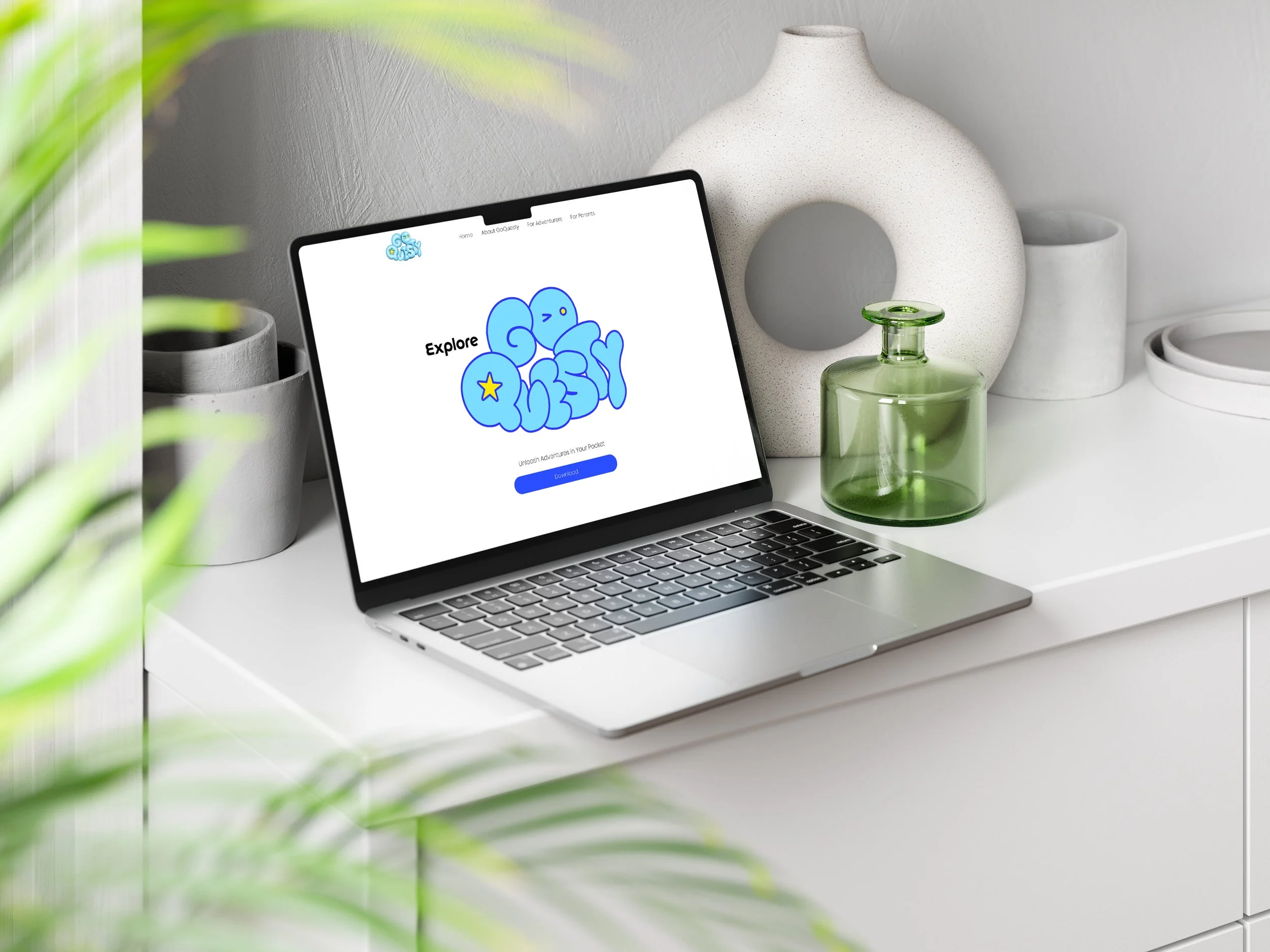
In order to ensure the outcome efficiently reaches our youthful target audience, we developed GoQuesty. We use digital technology such as a mobile app and social media platforms to extend our visual language into spaces where our target audience of the younger generation naturally and commonly interact. Through vibrant and bold colors, playful rounded typography, and layered energetic illustrations over images, we communicate excitement, diversity, and real-world interaction.
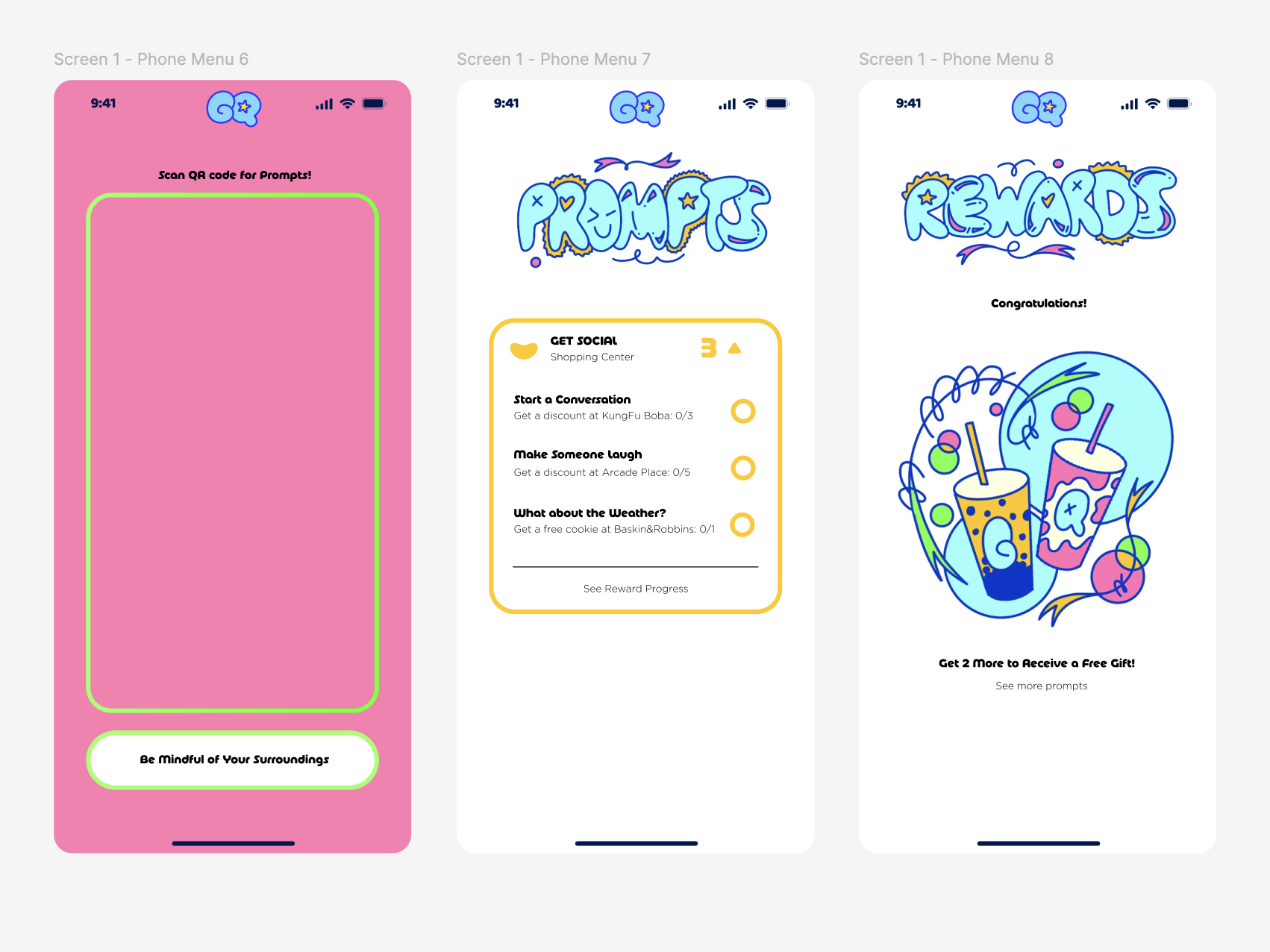
The app is designed to use engaging prompts, personalized suggestions, and gamified rewards to motivate teens to explore local spaces, meet up in person, and build social confidence. With the implementation of geolocation both benefits the younger audience and their parents by helps suggest nearby, teen-friendly places, making real-life experiences more accessible. At the same time, parents can opt into a safety dashboard to ensure peace of mind through location visibility and safe zone tracking.


Awareness That Matters
GoQuesty shines a light on local third places—from libraries to youth-friendly cafes—filtered by walkability, safety, and affordability around the user. Teens discover hidden gems; parents discover trusted options.
Choose Your Own Adventure
Gamified creative prompts turn everyday places into social quests—draw in a park, try a new snack, create a street photo challenge—pushing teens out the door and into shared memories and encouraging them to form relationships with peers.
Physical Meets Digital
Our mobile app and social media channels deliver challenges, track progress, and unlock real-world rewards. Every like, step, and meetup earns points, keeps teens engaged, and fuels healthy habits, ensuring decision-making freedom, all while building social and responsibility skills.
Safety Without Hovering
Promoted spots are well-lit, public, and sidewalk-accessible. For peace of mind, parents can opt into a Safety Dashboard with location visibility and safe zone alerts—no micromanaging needed.
Process / Research Paper
Interview Summaries
Third places—neutral, accessible hangouts outside home and school—were once central to teen social lives, offering freedom, community, and low-cost fun. Over time, accessibility and social safety have shifted, with fewer options, more isolation, and less organic community engagement for today’s teens.
Similarities Across Interviews:
Main Activities: Hanging out with friends (movies, cafes, skating rinks, malls, parks, friends’ houses. Informal socializing—laughing, goofing off, dating, and enjoying independence. Activities often included group outings, shared hobbies (sports, computer clubs), and events.
Accessibility: Relied on public transport, walking, carpooling, or parents for a ride. Most spaces were cheap or free; costs were covered by pocket money or parents.
Enjoyment Factors: Strong sense of independence and freedom from adult/academic supervision. Opportunity to form bonds, expand social circles, and “just be kids” outside of a structured environment. Feeling safe and connected within their communities.
Differences Between Past & Present
Diversity & Availability of Third-Spaces
Past (50s-90s): Wide range of options—teen clubs, skating rinks, arcades, recreation centers, fairs, grocery stores, and church lock-ins. The community felt more involved; activities encouraged mixing and meeting new people.
Present (Now): Limited to cafes/fast food, movies, friends’ houses. Few structured teen hangouts, like arcades or teen-only spaces. Teens wish for more options, but are unsure what those would be.
Community Feel & Social Safety
Past: Stronger community ties—knew neighbors and elders, minimal peer pressure, police presence, felt safe in public spaces.
Present: More uninterested in socialization, mainly interacts only with existing friends, not strangers. Social environments feel unsafe or less accessible, leading to fewer group activities.
Cost & Accessibility
Past: Even in rural areas, carpooling and cheap public transport made outings easy. Many activities were free or low-cost.
Present: Still accessible through transport, but fewer places to go, and outings rely more on parents.
Social Change Post-COVID
Recent Years: COVID-19 has reduced group hangouts, pushed more teens to stay home, and shrunk friend groups, resulting in fewer chances to make new friends or have spontaneous social experiences.
Past: Sleepovers, road trips, and community events were much more common, facilitating broader connections.
Key Takeaways
Then: Teens benefited from plentiful, varied third-places that supported community, safety, and independence, with organic opportunities to socialize.
Now: Teens are often left with fewer, more commercial or private options, rarely interact outside their friend groups, and may feel the lack of a broader, welcoming community.
Result: Modern teens are more isolated in their social lives and miss the communal, accessible third places that used to define youth culture.
What else did we find?
-
There is a notable decline in accessible, welcoming third places due to urban development, commercial pressures, increased regulation, and cultural shifts.
The absence of third places leads to social isolation, loneliness, less community engagement, and fewer organic friendships—especially impacting teens and young adults.
There’s a need to recognize the value of these spaces and advocate for their preservation or creation, for the health of both individuals and society.
-
Through several studies, we have learned that what is happening is mostly the exclusion of children and teens from spaces, and calls for more inclusive, child-friendly urban design that would allow young people to participate in public life as full city residents safely. Many studies’ key findings include how having access to private spaces plays a significant role in supporting children's emotional and behavioral development, and how the studies highlight the importance of educators recognizing and valuing these non-academic spaces as integral to students' social and emotional development.
-
Physical Location Comparisons:
Afterschool Programs vs Your Third Spot: Both strategies such as afterschool programs and ’Your Third Spot’ in Atlanta offer physical environments for the target audience to engage in, but their approaches to creating a third space differ. The Boys and Girls Club provides a structured environment that focuses on academic support, career readiness, and sports activities. While, Your Third Spot embraces a more casual, free-spirited and creative environment and allows the audience to decompress from academics and their home life.
Communication Comparisons:
Social Media Campaigns vs Urban Design Project: While both methods primarily focus on engaging the target audience by creating open, resourceful and meaningful conversations, they differ by language and who these communication strategies reach. On one hand, the social media campaigns boost youth engagement and can be easily spread, but their language often lacks call to actions. While projects and initiatives like PPS (Projects for Public Spaces) create conversations between the youth and local government to create public spaces like parks and plazas, but aren’t commonly marketing to teens using tools they commonly use (like social media) and the language is heavily urban design focused.
Digital vs Physical Comparisons:
Physical vs Digital Third Space: Despite their differences, both physical and digital third spaces are valid and sought out by the target audience as a way to build community, converse with friends, engage in their interests and create a path of self-discovery. Physical third spaces are currently becoming more and more uncommon with the rise of digital media, but these places provide in-person experience which develop soft skills such as conversing, communication and public speaking. On the other hand, digital third spaces are much more accessible though devices, are low cost, allow the target audience to develop important digital literacy skills and allow people to engage with media that directly interest them.
-
Tyler | Teenage/Adolescence Pain Points:
Limited amount of information on local hangout spots targeted or may be interesting to him by location. Lacks motivation or ideas on what to spend his day doing.
He has limited access to and information on a free and accessible third space that is walkable from his house or school.
Lack opportunities to make friends through both physical and digital activities.
Patricia | Parent Pain Points:
Wants her child to socialize and not stare at the screen entire day. Wants their child to learn to become independent and self sufficient without having to force them or motivate them to take action.
Lacks opportunities to ensure her kid to be safe, and away from harmful behaviors and lifestyles while ensuring their child still has independence.
Doesn’t want to have to drive & always accompany her son on outings with his friends, and wishes there was a safe place she knew she could trust for her son that isn’t a home or school.
Leading to the Solution
1 - Combining Digital Platforms With In-Person Experiences
Bridging the gap between digital engagement and tangible, in-person interaction amplifies both reach and impact.
Creating an experience that mixes physical activities and engagement with digital technology and motivation factors.
Integrating geolocation to find spaces, and ensure the parent knows where their child is while exploring.
2 - Remove Roadblocks to Teen Socialization
Initiating engagement and providing activity prompts.
Eliminating the barrier of 'not knowing where to go' through suggestions and recommendations of other adolescents and teenagers.
3 - Foster Youth Leadership and Authentic Inclusivity
To foster healthy social lives, it's crucial to identify and address these obstacles, making offline hangouts more accessible and attractive for both the teen and the parent. Leadership opportunities allow them to take ownership, while true inclusivity goes beyond accessibility to mirror their real identities, values, and interests.
Allowing teens to choose their own prompts and ensure they feel 100% in control of their actions.
Ensuring the target audience feel’s like they are not being told what to do.
Suggest activities and prompts based on the audience’s set interests to ensure they engage in activities that are meaningful and important to them.